


Are Gummy Vitamins Bad for Teeth? Sugar, Stickiness and Alternatives

A gummy vitamin can support a child’s nutrition and still leave a sticky trail on their teeth. The answer to whether gummy vitamins are bad for teeth is that they can raise cavity and enamel-wear concerns, especially when sugar or acids linger on tooth surfaces, but they aren’t automatically harmful. Ingredients, how often a child takes them, and their brushing routine all matter.
It’s understandable that gummies appeal to children: they’re easy to take and may feel more like a treat than a supplement. The goal isn’t to create worry, but to help you weigh that convenience against how sugar, acidity, and a sticky texture can affect a growing smile.
Here, we explain why gummies can cling to teeth, how timing and simple after-snack habits can help, and which alternatives may be gentler on teeth. You’ll also learn how to consider supplements alongside your child’s oral hygiene and everyday food choices.
Table of Contents
1. Are Gummy Vitamins Bad for Kids’ Teeth?
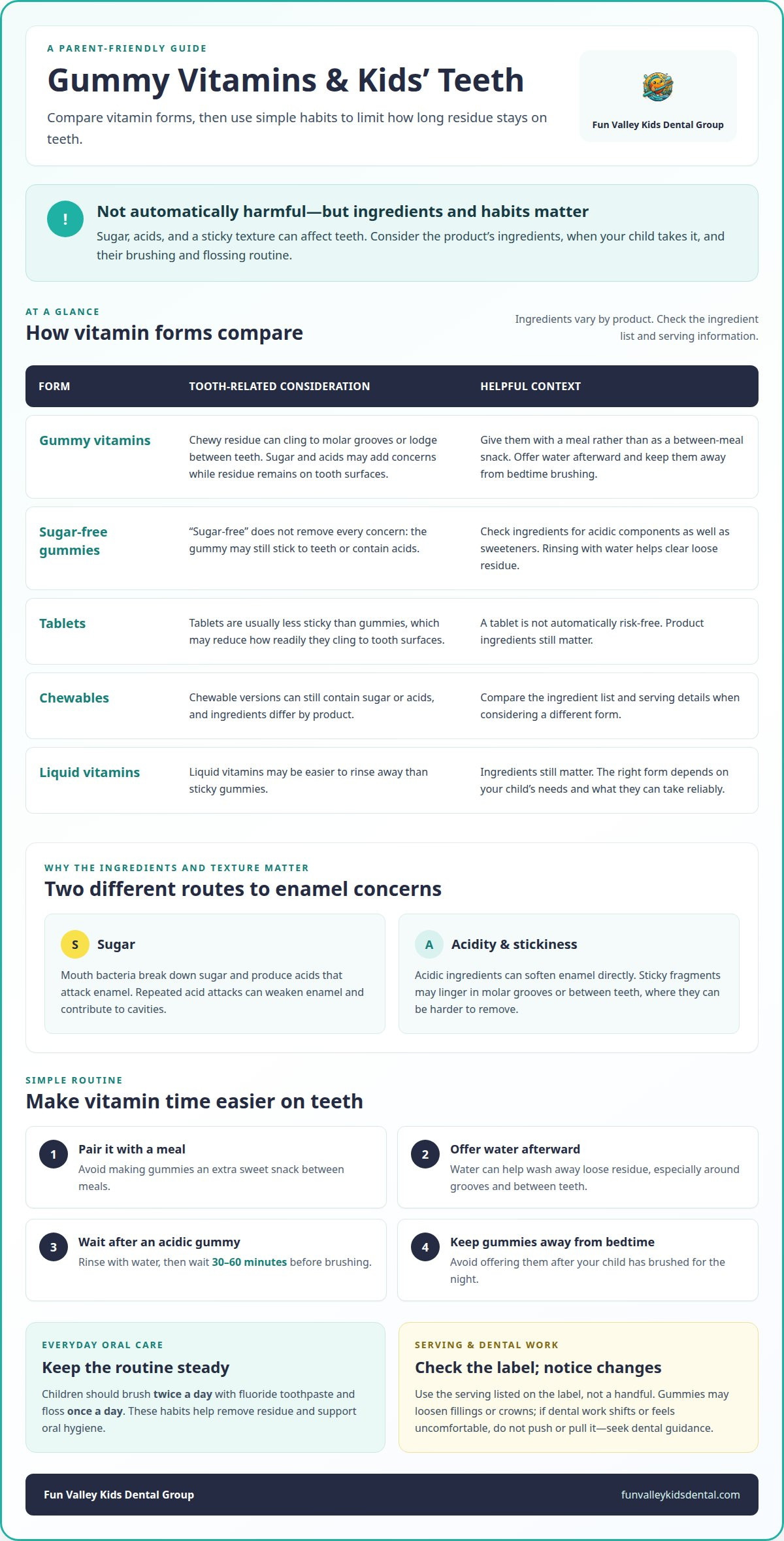
Gummy vitamins can support a child’s nutrition, but their sugar, acids, and sticky texture may affect teeth. Risk depends on ingredients, timing, and how well a child brushes and flosses. A gummy taken with breakfast and followed by water is different from one eaten after bedtime brushing. Children may also leave more residue behind when they haven’t mastered brushing and flossing.
Timing matters. Give gummies with a meal rather than as a between-meal snack, and avoid offering them at bedtime or after your child has brushed for the night. Saliva flow decreases during sleep, so residue can stay against teeth longer. If your child takes an acidic gummy, have them rinse with water, then wait 30–60 minutes before brushing. Brushing immediately after acid exposure can be harsh on softened enamel.
Organic or fruit-based labels don’t necessarily mean a gummy has no added sugar. Some products labeled organic or made with real fruit still contain added sugars or syrups. Check the ingredient list and nutrition information for sugar, sweeteners, and acidic ingredients. Even sugar-free gummies may stick to teeth or contain acids that can contribute to enamel wear, so “sugar-free” doesn’t remove every dental concern.
Are sugar-free gummy vitamins bad for teeth? They can still pose concerns because their texture may cling to teeth, and some contain acids. Rinsing with water after taking a gummy helps clear residue, especially from grooves and spaces between teeth. Regular brushing and flossing remain important. Children should brush twice a day with fluoride toothpaste.
Do dentists recommend avoiding gummy vitamins? Not necessarily. Practical steps include taking them with a meal, avoiding bedtime, and following with water. Tablets and liquids may leave less sticky residue, while gummies can lodge around molars or between teeth. Liquid vitamins may be easier to rinse away, but ingredients still matter. Choose a form that suits the child’s needs and can be taken reliably.
Sticky residue can also catch around dental work. Gummies may loosen fillings or crowns, so pay attention if a child says a restoration feels loose after eating one. Don’t pull or push at the dental work. Contact a dentist for guidance if it shifts, feels uncomfortable, or comes out.
For a simple routine, give the vitamin with a meal, offer water afterward, and keep it away from bedtime brushing. If the gummy is acidic, wait before brushing. These steps reduce how long sugar, acids, and sticky residue remain on a child’s teeth while keeping supplement time manageable.
2. Sugar and cavity risk
Sugar gives mouth bacteria fuel. As bacteria break it down, they produce acids that attack enamel, the hard outer layer of each tooth. Repeated acid attacks can weaken enamel and contribute to cavities. Acidic ingredients can also soften enamel directly, so sugar and acidity create different concerns. A gummy with both deserves attention for both reasons.
Gummy vitamins can expose teeth to sugar in a form that clings. Sugar content varies by product, so check the serving information rather than assuming one gummy equals one serving. Give only the serving listed on the label, not a handful. Eating more gummies increases exposure to their sugars and acids.
Sticky residue makes that exposure last. A gummy can lodge in a molar groove or between teeth, places a toothbrush may miss while a child is still learning to brush thoroughly. Sugar left in these spots can continue feeding bacteria after the gummy is gone. Regular brushing and flossing help remove residue. Children should brush twice a day with fluoride toothpaste and floss once a day.
Children may have more difficulty clearing gummy residue because brushing and flossing skills are still developing. Baby teeth need care, too. A cavity in a baby tooth can cause infection if left untreated, so don’t dismiss a new dark spot or tooth discomfort simply because the tooth will eventually fall out. Pain when chewing or a visible change deserves attention.
Tablets are usually less sticky than gummies, which may reduce how readily they cling to tooth surfaces. That doesn’t make every tablet risk-free: chewable versions can still contain sugar or acids, and ingredients differ by product. Sugar-free gummies also aren’t automatically free of concern, since they may remain sticky or contain acids that wear enamel. Compare the ingredient list and serving details when considering a different form.
For everyday protection, take vitamins with a meal and maintain a brushing and flossing routine. Avoid letting vitamins become an extra sweet snack between meals. Water after eating helps clear loose residue, while brushing and flossing target what remains. These habits reduce exposure without requiring parents to treat every gummy as a guaranteed cause of decay.
If a child has tooth pain, visible spots, or recurring cavities, a pediatric dental exam can help assess their teeth and identify next steps.
3. How gummy texture makes vitamins stick to teeth
A gummy’s chewy texture can make it cling instead of sliding away after a bite. As a child chews, its soft, candy-like shape presses against tooth surfaces, especially the grooves on molars. Pieces may also lodge between teeth. That keeps the gummy’s ingredients in contact with enamel longer than a form that rinses or breaks apart more easily.
Molars have uneven chewing surfaces, with narrow grooves that can trap small bits of food. A gummy fragment caught there may be difficult for a young child to notice or remove by brushing. The same can happen between neighboring teeth, where a toothbrush may not reach. Sticky residue in these spots can remain after the child has finished eating.
Saliva helps move material around the mouth, but it may not quickly clear every sticky fragment. A drink of water after a gummy can help wash away loose residue. Parents can also look for visible bits around the back teeth, where a child may not see them easily. Water is a simple first step, not a substitute for cleaning teeth.
Residue can collect near the gumline as well as on tooth surfaces. If a gummy leaves a film around the edges of the teeth, a child may miss it while brushing quickly. Gentle brushing along the gumline and flossing between teeth can help remove material from those narrow spaces. This supports oral health by helping keep the area clean.
Texture affects tooth contact even when the ingredients differ. A sugar-free gummy may still be sticky, while a gummy with fruit ingredients can still adhere to molar grooves. The label alone doesn’t explain how the product behaves in a child’s mouth. For example, a gummy that stretches or clings during chewing may leave more residue than a vitamin that dissolves or washes away.
Sticky residue doesn’t mean tooth decay will automatically follow. It does mean gummy pieces can keep their ingredients close to enamel until they’re cleared. A helpful routine is to offer water after the vitamin, then make sure the child’s regular cleaning reaches molars and spaces between teeth. If residue remains near the gums, slow down and clean that area gently.
Tooth contact is one reason parents may consider alternatives with a different texture. Tablets, liquid vitamins, or swallowable forms don’t create the same chewy coating, though ingredients still matter. For a child who struggles to remove residue from molar grooves, a form that’s easy to take and clean around may make the daily routine more manageable.
4. Choosing alternative vitamin forms
Choose a vitamin form based on your child, not the package’s cheerful flavor. Consider age, diet, healthcare needs, and what your child can take comfortably. A pediatrician or dentist can help determine whether a supplement is appropriate. If it is, compare chewable tablets, liquids, swallowable pills, and dissolving vitamins by ingredients and ease of use.
Chewable tablets may be a practical middle ground for children who dislike gummies but can chew tablets safely. They’re generally less sticky than gummies, though some contain sugar or acidic ingredients such as citric acid. Read the ingredient list and serving directions. A chewable tablet still calls for good oral care, especially if it leaves a sweet or sour taste.
Liquid vitamins can suit children who have difficulty chewing or swallowing a tablet. Their ingredients vary, so check for added sugar and acids rather than assuming every liquid is tooth-friendly. After a dose, offer water to help rinse the mouth. Follow the product’s directions, and don’t mix a supplement into a drink unless its label allows that use.
Swallowable pills avoid prolonged chewing, but they’re a sensible option only when a child can take them comfortably. A child who struggles with pills may do better with a liquid or chewable form. Choose according to the child’s age and ability, not simply the format that seems easiest for adults. Store supplements securely out of children’s reach.
Dissolving vitamins offer another non-gummy option. Some sugar-free dissolvable products use plant-based sweeteners instead of sugar, but ingredients still deserve attention. A dissolving tablet may remain in the mouth as it breaks down, so check whether it contains acids or sweeteners. “Sugar-free” alone doesn’t describe every ingredient that could affect teeth.
Food can provide nutrients without adding a gummy to the routine. Examples of fortified foods include oatmeal, milk, and yogurt. Leafy greens, berries, and whole grains also provide nutrients; dairy foods such as cheese and yogurt provide calcium. Food choices support nutrition, but they don’t automatically replace a supplement prescribed for a child’s needs.
For a practical comparison, check the serving directions, sugar, and acidic ingredients first. Then consider whether your child can take that form consistently. If gummies are the only form your child accepts, focus on meal timing and the cleaning habits discussed earlier. The aim is to meet nutrition needs while choosing a format that fits your child’s daily routine and oral care.
5. Tooth-friendlier vitamin forms
A tooth-friendlier vitamin meets a child’s nutrition needs without leaving a sugary, sticky coating. Sugar-free dissolvable vitamins can use plant-based sweeteners instead of sugar, and some forms dissolve under the tongue. Still, check the full ingredient list: sugar-free doesn’t automatically mean acid-free, and an acidic product can affect enamel.
Chewable tablets are another option for children who don’t swallow pills comfortably. They’re less sticky than gummies, but some contain sugar or acids. Check the serving directions and ingredients, including citric acid, before choosing. A tablet’s shape doesn’t tell you whether it’s sweetened, so compare the label rather than relying on flavor or packaging.
Liquid vitamins can work for children who have difficulty chewing or swallowing. The liquid form doesn’t leave the same chewy material in molar grooves, but its ingredients still matter. Check for added sugar and acids, then offer water after the dose to help rinse the mouth. Follow the product’s directions rather than changing how much you give.
Swallowable pills avoid chewing a supplement against the teeth. They can be a poor fit if a child isn’t comfortable swallowing them. A dissolving tablet differs from a swallowed pill because it stays in the mouth while it dissolves. For either form, consider your child’s ability and the product’s ingredients.
Food can provide nutrients alongside supplements. Oatmeal, milk, and yogurt are examples of vitamin-fortified foods; leafy greens, berries, and whole grains also provide nutrients children need. Calcium and vitamin D support developing teeth. These foods are options to discuss as part of a child’s diet, not automatic replacements for a supplement that meets a specific health need.
Use a simple comparison when choosing: check the ingredients, consider how the form contacts teeth, and think about what your child can take consistently. The right choice depends on age, diet, and healthcare needs. A pediatrician or dentist can help you decide whether a supplement is needed and which form fits your child.
Tooth-friendly choices also work alongside regular oral care. If sticky residue is hard to remove, or you notice a change in your child’s teeth, a pediatric dentistry appointment can help assess their oral health. Schedule a pediatric dental appointment for an evaluation and guidance for your child’s smile.
Fun Valley Kids Dental Group
Fun Valley Kids Dental Group helps families in Sun Valley and nearby communities understand how a child’s daily habits may affect their teeth. During a pediatric dental exam, the team can assess your child’s teeth and discuss gummy vitamins, brushing, and oral care. Dental cleanings and preventive care support children’s oral health.
Book an appointment if you notice tooth sensitivity, visible spots, or a filling or crown that feels loose. Regular visits also give parents a chance to discuss prevention as a child’s teeth develop.
Contact Fun Valley Kids Dental Group to arrange a pediatric dental appointment.
Make the Next Choice with Confidence
Understanding whether gummy vitamins are bad for teeth is only one part of choosing what works for your child. Consider the whole routine: what supplement your child takes, how they manage it, and whether their teeth need attention. A calm, practical conversation can help you decide what to discuss with a dental professional and what to discuss with your child’s healthcare provider.
Before an appointment, note the vitamin’s name and ingredients, when your child takes it, and any changes you’ve noticed, such as sensitivity or a spot on a tooth. These details give the dental team useful context without turning supplement time into a source of worry. You can also share where brushing feels tricky, such as around back teeth or between teeth.
For guidance about your child’s teeth and oral-care routine, contact Fun Valley Kids Dental Group. Every small, steady step can help your child move forward with a healthier, more confident smile.
Frequently Asked Questions
Do the benefits of gummy or chewable vitamins and supplements mediate their oral health drawbacks?
Gummy vitamins can be useful when a child needs a supplement, but nutritional benefits don’t erase possible effects on teeth. Whether a supplement is needed depends on a child’s diet and health needs, so discuss that choice with their pediatrician. If gummies are the only form your child accepts, taking the recommended serving with food and maintaining regular oral care can help balance convenience with dental health.
Are Gummy Vitamins Bad for Kids’ Teeth?
Gummy vitamins can raise concerns about cavities or enamel wear, but they don’t automatically harm every child’s teeth. The risk depends on the ingredients, how often a child takes them, and how well they clean their teeth. A child who struggles to brush around back molars may leave residue behind. If you notice a new spot, sensitivity, or pain, arrange a dental assessment rather than assuming a vitamin caused it.
And for adults?
The same basic concerns apply to adults: sugars can feed mouth bacteria, and sticky pieces can cling to tooth surfaces. Adults who brush and floss effectively may clear residue more reliably, but dental work, crowded teeth, or hard-to-reach areas can make cleaning difficult. Check the supplement’s ingredients and serving directions. If a gummy catches around a filling or crown, avoid tugging at it and seek dental advice if the restoration feels loose.
Are Gummy Vitamins Worse Than Candy?
Not necessarily. Sugar content differs by product and candy type. Check the nutrition information to compare sugar content rather than relying on a “vitamin” label or fruit-based flavor. Take a supplement as directed, not as candy or an extra snack.
Are gummies and chewables as much of a risk to oral health as candy?
The risk depends on ingredients and texture, not just whether something is called candy or a supplement. Sugary gummies can cling to teeth, while chewable tablets are generally less sticky but may still contain sugar or acids. Sugar-free products can also remain sticky or contain acidic ingredients. Check the label and consider how easily your child can clean their teeth after taking the product.
Do chewables and gummies affect other parts of the mouth, or just the teeth?
The clearest concern is contact with teeth, especially where a sticky piece lodges between teeth or in molar grooves. Residue can also collect close to the gumline, where quick brushing may miss it. That doesn’t mean a gummy will cause gum disease. If your child has ongoing soreness, bleeding, or irritation, note when it happens and discuss it with a dental professional.
Do vitamins ever help teeth?
Yes. Calcium and vitamin D support developing teeth, and nutrients from a balanced diet contribute to a child’s overall health. Food examples include milk, yogurt, leafy greens, berries, and fortified oatmeal. Supplements aren’t needed by every child, and they don’t replace brushing, flossing, or dental visits. Choose a supplement based on your child’s age, diet, and healthcare needs with guidance from a pediatrician or dentist.
How Can Parents Reduce the Dental Risks?
Give the vitamin with a meal, follow its serving directions, and offer water afterward. Keep gummies away from bedtime, when brushing is finished. If a gummy contains acidic ingredients, rinse with water and wait 30–60 minutes before brushing. Help your child clean molars and floss between teeth, especially if they’re still learning those steps. Store vitamins securely out of children’s reach.



Comments