


Explaining Orthodontics to a Pre-Teen: Braces and Timing

What if an early orthodontic visit is about spotting a concern, not rushing into braces? When explaining orthodontics to a pre-teen, it helps to know that early treatment is only recommended when a child’s developing teeth or bite may benefit. The American Association of Orthodontists recommends an initial orthodontic evaluation by age 7, but many children don’t need treatment right away.
It’s natural to wonder whether crooked teeth mean braces are just around the corner. Often, the first step is simply understanding how the teeth and jaws are growing. Early treatment may help address concerns such as severe crowding, a crossbite, or a pronounced overbite or underbite, while other children can wait until more permanent teeth arrive.
This guide explains what Phase 1 treatment aims to do, which bite and alignment concerns may prompt an evaluation, and when to arrange one. You’ll also learn what teens may wear, from traditional braces to clear aligners, and why the right option depends on tooth position, bite, and dental development. Think of it as a calmer map for a big family milestone, with room for your pre-teen to ask questions along the way.
Table of Contents
Phase 1 Orthodontics Explained: Does My Child Need Early Treatment?
Phase 1 orthodontics addresses certain developing bite or alignment concerns while children still have baby and permanent teeth. Early care isn’t necessary for every child; an evaluation helps identify who may benefit and when treatment can wait.
Timing Treatment Around Adolescence
Adolescence can suit orthodontic treatment because permanent teeth are still settling into position. Phase II treatment often takes place between ages 11 and 15, when many children have more permanent teeth.
An orthodontic exam gives the orthodontist a chance to assess tooth position, the bite, and dental development before discussing braces. Growth matters, too. A pre-teen with a developing bite concern may need a different plan from a child whose teeth are still changing significantly.
Age alone doesn’t determine when treatment should start. Think of timing as matching the plan to your child’s changing dental development, rather than treating a birthday as a fixed signal.
Deciding Whether Early Treatment Is Needed
A dental professional evaluates the child’s teeth, bite, and dental development to decide whether early orthodontic treatment may help. The American Association of Orthodontists recommends an initial orthodontic evaluation by age 7, but an evaluation doesn’t mean braces must begin then.
Many children don’t need Phase 1 treatment. The professional considers whether a concern is likely to affect the way permanent teeth come in or how the upper and lower teeth meet. A child with visible crowding, for example, may need assessment, while another child may simply need observation as teeth develop.
Ask what the evaluation found, whether treatment is recommended now, and what changes the orthodontist will monitor. These details help your family understand the reason for a recommendation and discuss the next step together.
Treating Crowding, Spacing, and Bite Problems
Orthodontic treatment can address crowded teeth, gaps, and bite problems by guiding teeth toward better positions. The plan depends on the individual pattern, not just whether teeth look crooked in a smile.
Severe crowding may leave too little room for permanent teeth to emerge normally. Early treatment can sometimes create space and guide eruption. A narrow upper jaw may contribute to a crossbite, where upper teeth bite inside lower teeth. The orthodontist assesses the jaw and bite before recommending an approach.
Spacing and other bite concerns also need an individual assessment. A visible gap or uneven bite is a reason to discuss an evaluation, not proof that braces are needed.
Why Treatment May Have Two Phases
Two-phase orthodontic treatment separates early guidance from later, comprehensive care. Phase 1 addresses a specific concern while a child has both baby and permanent teeth; Phase II may align the permanent teeth after they come in.
Early treatment may help guide eruption or address a developing bite problem, but it doesn’t replace a later phase when comprehensive orthodontic care is still needed. A child may have a resting period while remaining teeth emerge, followed by another assessment of alignment.
This approach isn’t necessary for every child. The orthodontist explains whether an initial phase addresses a specific need and what signs will guide later planning. Understanding the purpose of each phase makes the overall treatment path easier to explain to a pre-teen.
What Types of Braces Are Available for Teens?
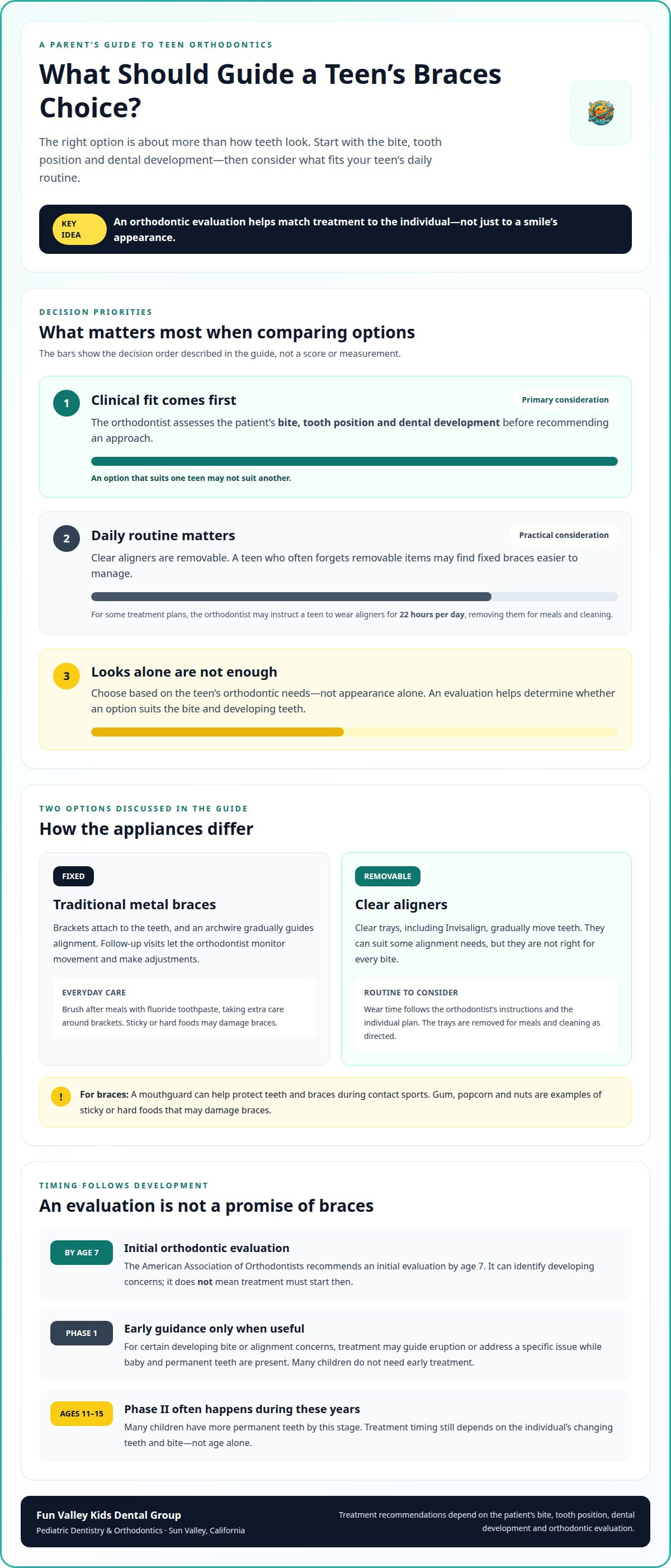
Teens may have different orthodontic options, and the right choice depends on their individual needs. An orthodontic evaluation helps match treatment to the patient rather than choosing by appearance alone.
Traditional metal braces use brackets attached to teeth and an archwire that gradually guides alignment. Other brace designs, such as ceramic, lingual, and self-ligating braces, are general examples of orthodontic options and are not necessarily offered at Fun Valley Kids Dental Group. A teen’s daily routine matters when considering treatment.
Clear aligners, including Invisalign, are removable trays that move teeth gradually. They can suit some alignment needs, but aren’t right for every bite. Depending on the orthodontist’s instructions and the individual treatment plan, a teen may be asked to wear aligners for 22 hours per day, removing them for meals and cleaning. A teen who often forgets removable items may find fixed braces easier to manage.
Comprehensive treatment may start after more permanent teeth have arrived. Some children who had Phase 1 treatment may later need braces or aligners to refine tooth positions. Phase 1 doesn’t replace Phase 2 when comprehensive care is still needed; the orthodontist assesses the developing bite and teeth before recommending the next step.
Getting braces usually involves attaching brackets and fitting the archwire. Follow-up visits allow the orthodontist to monitor tooth movement and make adjustments. Some temporary soreness after placement or an adjustment is normal and usually manageable. When explaining orthodontics to a pre-teen, keep it simple: the orthodontist places small brackets and checks how the teeth are moving.
Daily habits help protect braces and keep teeth clean. Brush after meals with fluoride toothpaste, taking extra care around brackets. Sticky or hard foods, such as gum, popcorn, and nuts, may damage braces. During contact sports, a mouthguard can help protect the teeth and braces.
Music can be part of the conversation too. A teen who plays a wind instrument can ask the orthodontist what to expect while adjusting to braces, then plan practice with patience. Invite your teen to bring questions about treatment and daily routines to the appointment. For guidance on options, an orthodontic evaluation can help clarify which approach fits a teen’s bite and routine.
When Should Teens Get an Orthodontic Evaluation?
The American Association of Orthodontists recommends an initial orthodontic evaluation by age 7. An evaluation can identify developing concerns without committing a child to braces.
Timing an Initial Evaluation
Age 7 is the recommended milestone for a child’s first orthodontic evaluation. The American Association of Orthodontists recommends that every child in the United States have this evaluation by then. This early visit gives an orthodontist a chance to assess emerging bite and alignment concerns while a child’s teeth are developing.
An evaluation at age 7 doesn’t mean treatment starts at age 7. Some children need no orthodontic care, while others benefit from observation or an earlier plan. For teens who haven’t had an evaluation, it’s still useful to assess their bite, crowding, and dental development before deciding whether treatment makes sense.
A parent or dentist may suggest an orthodontic evaluation if they notice a concern, such as teeth that don’t meet evenly. You don’t need to wait until braces seem necessary. An orthodontist can explain whether the bite and tooth positions appear typical or need attention.
Evaluation and Diagnosis
An orthodontic evaluation examines how the teeth fit together, how they’re positioned, and how dental development is progressing. The orthodontist uses these findings to identify concerns such as crowding or a crossbite and determine whether treatment, monitoring, or no action is appropriate.
Parents can ask what the orthodontist sees, how the bite affects the plan, and whether treatment should begin now or later. For example, ask whether crowded teeth need attention immediately or can be observed as permanent teeth emerge. These questions help turn clinical terms into a clear map for the family.
Useful questions include:
Which teeth or bite concerns did the evaluation identify?
Does the patient need treatment now, later, or only monitoring?
What changes in tooth position would affect the recommendation?
If braces are recommended, what is their purpose for this patient?
Ask the orthodontist to explain unfamiliar terms, such as “crossbite,” using your teen’s own bite as an example. You can also ask what changes should prompt another assessment. A clear explanation helps a pre-teen understand the next step without assuming every uneven tooth needs braces.
What Phase 1 orthodontics is and its goals
For a child, orthodontics means guiding teeth and bites as they grow. Braces or other appliances can help direct tooth position. Brief soreness may follow placement or adjustments; contact the orthodontist if discomfort persists.
The Purpose of Phase 1 Treatment
Phase 1 is early orthodontic care during mixed dentition, when children have both baby teeth and permanent teeth. Its goal is to address a developing concern while the jaw and teeth are still growing.
For example, an orthodontist may recommend early care for a crossbite or a large overbite. Treatment may guide eruption or create room for permanent teeth. This doesn’t mean every child needs early treatment, or that Phase 1 replaces later comprehensive care.
Common Phase 1 Appliances
A palatal expander widens the upper jaw. An orthodontist may recommend one when a narrow upper jaw contributes to a crossbite.
An expander works differently from braces: it focuses on the width of the upper jaw rather than aligning individual teeth. The orthodontist explains how it fits, what changes to expect, and how it relates to the child’s bite. This gives parents and children a clearer understanding of its purpose.
Other orthodontic appliances serve different goals, so the right choice depends on the patient’s teeth and bite. A specific concern, such as protruding front teeth or a crossbite, helps shape the recommendation. Parents can ask the orthodontist to show which area the appliance is meant to guide.
After Phase 1, a child may wear a nighttime retainer to hold the treatment results. During a resting period, growth checks take place every 6 to 12 months. These visits let the orthodontist follow changes as permanent teeth emerge and decide when another assessment is useful.
A retainer has a different job from an expander: it helps maintain the position reached during treatment. Explain it to a pre-teen as a holder that supports the work already done. The orthodontist can describe when to wear it and how it fits into eating and bedtime routines.
Phase 1 treatment may be followed by a resting period lasting a couple of years. That interval isn’t a sign that orthodontic care has stopped; the child’s growth and incoming teeth continue to develop. The orthodontist monitors those changes before planning any later treatment.
Parents can make the plan easier to understand by naming each step: the appliance’s purpose, retainer use, and growth checks. For example, tell a child with a crossbite that the expander is meant to widen the upper jaw. Clear, concrete explanations help turn unfamiliar appliances into understandable parts of the journey.
Common orthodontic conditions in teens
Teen orthodontic concerns often involve crowded or spaced teeth, or a bite that doesn’t fit evenly. Naming the pattern helps parents understand what an orthodontic evaluation examines and why treatment timing can vary.
Crowding and spacing
Crowding occurs when teeth compete for room, while spacing means there are gaps between teeth. For example, a permanent tooth may emerge beside another tooth instead of lining up with it. An orthodontist considers tooth position and the bite to understand the pattern.
Spacing and crowding don’t automatically call for the same treatment. Braces or clear aligners may be considered based on the individual’s teeth and bite. For a teen, an orthodontist can explain whether the concern affects alignment or needs monitoring as dental development continues.
Crossbites and uneven bites
A crossbite occurs when upper teeth bite inside the lower teeth in part of the mouth. For example, a back-tooth crossbite involves upper and lower teeth meeting in the wrong relationship. An orthodontist assesses how the teeth fit and whether jaw growth plays a role.
Other bite patterns include an overbite, where upper front teeth overlap lower front teeth, and an underbite, where lower teeth sit ahead of upper teeth. These descriptions help families talk about what they see, but an orthodontic assessment examines the full bite, not just one tooth.
Why timing and the specific pattern matter
Two teens with crooked front teeth may have different orthodontic needs. One may have crowding; another may have a concern involving the jaws and bite. The orthodontist considers tooth position, the bite, and dental development before discussing braces or aligners.
Jaw growth can also affect treatment planning. A developing underbite or pronounced overjet, where upper front teeth protrude, may prompt a discussion about timing. The goal is to understand the concern and how it relates to the teen’s growth, rather than choosing treatment based only on appearance.
Braces come in different forms, including traditional metal and less noticeable ceramic options. Clear aligners are removable, but suitability depends on the patient’s bite and tooth position. An orthodontic evaluation helps explain which approaches fit the condition and the teen’s needs.
Parents can ask the orthodontist to name the bite or alignment issue, point out how it appears, and explain how timing affects the plan. For guidance on a teen’s crowding, crossbite, or underbite, schedule an orthodontic evaluation.
Fun Valley Kids Dental Group
Fun Valley Kids Dental Group helps families keep children’s dental care on track while they consider orthodontic timing. A pediatric dental exam lets the care team review your child’s oral health and discuss concerns with you. Cleanings and preventive care support children’s oral health as they grow.
If your pre-teen has questions about braces, crowding, or bite changes, share them during a visit. Clear explanations can help your family understand what to discuss next and make the conversation more comfortable for your child. Contact Fun Valley Kids Dental Group in Sun Valley to arrange a visit. The practice serves families in Sun Valley, Pacoima, Arleta, Panorama City, North Hollywood, Burbank, and Sylmar.
Make the Next Conversation a Team Effort
Your pre-teen may have questions that feel bigger than braces themselves: Will treatment change how I look? What if I feel awkward at school? When explaining orthodontics to a pre-teen, listen first, then answer with simple, honest language. You don’t need to settle every question at home. Write down what your child wants to understand and bring those questions to an appointment.
Invite your teen to take part in the conversation. They might describe what matters to them, ask how treatment could fit their daily routine, or simply listen while you talk with the orthodontist. This can help the next visit feel more like a shared decision than a surprise.
For guidance on your child’s dental care and questions about what comes next, contact Fun Valley Kids Dental Group. Keep the conversation open, one question at a time, and let your pre-teen know you’ll explore the next steps together.
Frequently Asked Questions
What Happens During the Resting Phase?
During a resting phase, the orthodontist monitors the child’s dental development and gives the family home-care guidance. Keep scheduled visits and tell the office if an appliance is lost, damaged, or uncomfortable. Note changes you notice, such as a new tooth appearing or a change in the bite. Sharing these observations makes each check-in more useful.
Are baby teeth ever moved for cosmetic reasons?
Moving baby teeth solely to improve appearance is not usually the reason for early orthodontic care. An orthodontist considers whether a tooth’s position affects function, the bite, or the path of an incoming permanent tooth. If appearance concerns affect your child’s confidence, raise them gently during an evaluation. The orthodontist can explain whether treatment could address a dental concern.
Can Phase 1 treatment help with mouth breathing, snoring, or speech problems?
Phase 1 orthodontic treatment shouldn’t be assumed to resolve mouth breathing, snoring, or speech difficulties. These concerns may need assessment beyond tooth alignment. Tell the orthodontist what happens and when, such as snoring during sleep or difficulty pronouncing particular sounds. The details help the professional explain whether the child’s bite or jaw is relevant and whether another type of assessment may be appropriate.
Does Phase I + Phase II Mean More Time in Braces Overall?
Two treatment phases don’t necessarily mean a child spends more time wearing braces. A plan may include active treatment, a period without braces, and later care if developing teeth need it. Ask the orthodontist to distinguish active appliance time from the full calendar span and explain what could change the plan. This helps your family understand the schedule without assuming every child follows the same path.
Why might a pre-teen need braces or other orthodontic treatment?
A pre-teen may be considered for orthodontic treatment when the teeth or bite need help functioning or fitting together. You might mention a tooth that seems blocked from emerging, difficulty biting comfortably, or a visible change in how the jaws meet. These observations are useful context, not a diagnosis. The orthodontist can explain which findings matter and how they relate to your child’s comfort and dental development.
What happens at an orthodontic consultation and evaluation?
An orthodontic consultation gives your family time to discuss concerns and understand the proposed next step. Before the visit, write down questions and bring any relevant dental history or records you already have. Ask the orthodontist to explain unfamiliar terms and clarify whether the recommendation is treatment, monitoring, or no immediate action. Your pre-teen can also share what they’d like to know.
What are the differences between metal braces, ceramic braces, and clear aligners for pre-teens?
Beyond appearance, orthodontic options differ in how they fit into a teen’s habits. Fixed braces stay attached during meals, while removable aligners need careful handling when taken out. A teen who plays an instrument, participates in sports, or often misplaces small items can discuss those routines during treatment planning. The orthodontist can weigh these practical details alongside the bite and tooth positions before recommending an option.
At what age should a child see an orthodontist?
The American Association of Orthodontists recommends an initial orthodontic evaluation by age 7. If your child is older and hasn’t had one, arranging an evaluation can still provide a useful picture of their current bite and dental development. Bring up any changes you’ve noticed, such as a tooth emerging in an unexpected position. The visit helps clarify whether the next step is care, observation, or simply continuing routine dental visits.

Comments