


Pediatric Dental Care in Los Angeles for Children

A good pediatric dentist combines training focused on children, a calm approach, and care suited to your family’s needs. To understand how to find a good pediatric dentist in Los Angeles, compare the dentist’s experience with children, the services offered, accepted insurance, and communication style. A welcoming setting matters, too, especially if your child feels nervous about dental visits.
It’s natural to want more than a convenient appointment. You want a dentist who explains what’s happening in child-friendly language, listens to your concerns, and helps your child feel safe and included.
This guide explains what pediatric dental care can include and how to assess a dentist’s experience, services, insurance acceptance, and approach to communication. You’ll also find practical ways to compare practices and decide whether a pediatric dentist suits your child’s needs. With a clear checklist, you can make the search feel less like guesswork and choose a comfortable starting point for your child’s dental care.
Table of Contents
Insurance acceptance and bilingual staff
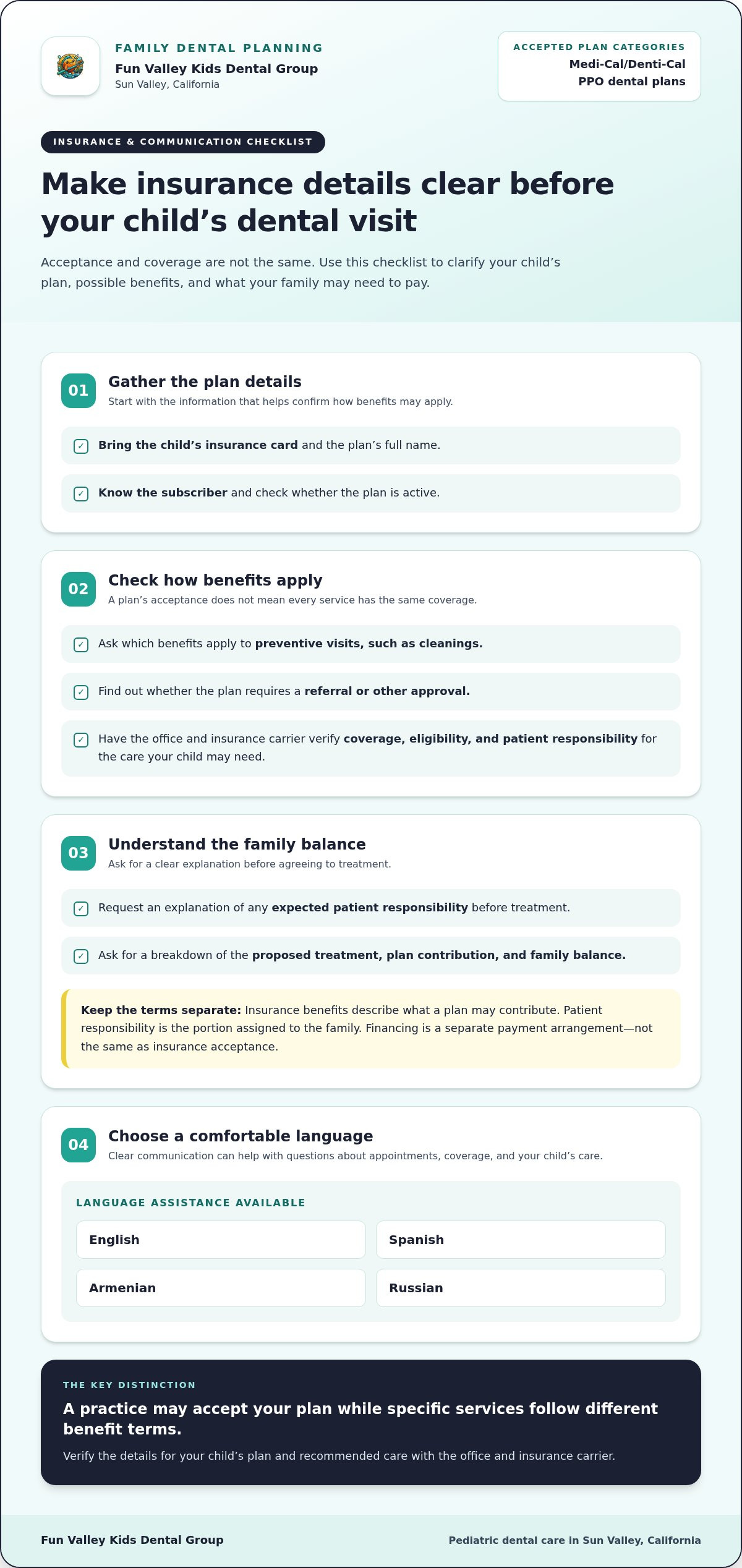
Insurance acceptance can make routine dental care easier to plan, but acceptance and coverage are not the same. A practice may accept a plan while a particular service has separate eligibility rules or limits. Before booking, identify the child’s exact plan name, the subscriber, and whether the plan is active. This information helps clarify how benefits apply to the care your child may need.
At the Sun Valley practice, accepted plan categories include Medi-Cal/Denti-Cal and PPO dental plans. Parents should distinguish the insurance network from the services their child may need. For example, a plan may list dental cleanings as a covered service, while other care follows different benefit terms. Coverage, eligibility, and patient responsibility depend on the plan and treatment. Have the office and insurance carrier verify those details before care.
Use this short preparation list when comparing insurance and payment options:
Bring the child’s insurance card and the plan’s full name.
Ask which benefits apply to preventive visits, such as cleanings.
Find out whether the plan requires a referral or other approval.
Request an explanation of any expected patient responsibility before treatment.
For affordability, look beyond whether a practice accepts your plan. Consider how often your child may need appointments, which preventive services are included, and how the plan handles recommended treatment. For example, a parent comparing two plans can list the benefits for cleanings separately from benefits for restorative care. This makes gaps easier to spot without assuming that every service is paid in full.
Insurance, payment, and financing are related, but they are not interchangeable. Insurance benefits describe what a plan may contribute; patient responsibility is the portion assigned to the family. Financing refers to a separate payment arrangement, so don’t assume it is included with insurance acceptance. Ask for a clear breakdown of the proposed treatment, plan contribution, and family balance before agreeing to care.
Language support also affects how confidently parents can discuss benefits and a child’s needs. The Sun Valley practice can assist families in English, Spanish, Armenian, and Russian. Parents can choose the language they’re most comfortable using for questions about an appointment, coverage, or a child’s care. Clear communication helps families understand next steps and support a healthy smile without confusion.
Dentist background and experience with children and special-needs dentistry
A child’s dental appointment calls for more than a quick look at teeth. Pediatric dentists focus on children’s teeth, gums, and mouths, with a range of treatment options suited to young patients. As you compare backgrounds, look for clear information about pediatric training and hands-on experience with children at different stages of dental development. A child’s needs can change as baby teeth give way to permanent teeth.
Experience matters in the treatment room, too. Notice whether the dentist explains each step in child-friendly language, listens to parents, and gives a child time to settle in. A nervous child, for example, may benefit from a calm introduction to the chair and instruments before an examination begins. A thoughtful approach helps children understand what is coming rather than feeling surprised.
Special-needs dentistry calls for attention to the individual child, not assumptions based on a diagnosis. Sensory sensitivities, communication preferences, mobility needs, medical history, or difficulty sitting for care can affect how a visit is planned. Share relevant details before the appointment, including what helps your child feel comfortable and what may cause distress. This helps the dental team discuss an appropriate approach to care.
Consider practical examples. A child who finds bright lights uncomfortable may benefit from a quieter introduction to the treatment room. A child who communicates nonverbally may feel more comfortable if the caregiver explains familiar cues and ways to signal a pause. These examples don’t replace clinical evaluation; they help the dental team understand the child’s needs and plan the visit thoughtfully.
Use these steps to assess whether a dentist’s experience fits your family:
Review the dentist’s pediatric background and experience caring for children.
Describe your child’s communication, sensory, mobility, or medical needs before the visit.
Notice whether explanations are directed to both the child and caregiver.
Discuss what helps your child participate, including breaks or familiar comfort items.
A child’s first dental visit should happen by the first birthday or within six months after the first tooth appears. That early appointment gives families a chance to discuss development, daily care, and any concerns before they become harder to address. For children with additional needs, sharing useful details ahead of time can make the visit more predictable. Explore child-focused dental care as you consider a comfortable next step for your family.
Pediatric dentists’ training and expertise
A pediatric dentist focuses on children’s teeth, gums, and mouths. The American Academy of Pediatric Dentistry describes pediatric dentists as offering a wide range of treatment options and expertise in caring for children. That focus matters because a child’s dental needs change as teeth develop. Ask how the dentist’s experience prepares them to examine children and explain care at different developmental stages.
Look for clear, specific information about the dentist’s background and experience caring for children. Don’t assume a title alone tells you how visits are handled. A dentist who explains how they introduce an exam, respond to a child’s concerns, and involve caregivers gives you a clearer picture of their approach.
Expertise also shows in how a dentist explains findings. During a checkup, parents should be able to understand what the dentist observed, what care may address it, and why a recommendation suits the child. If a child has a cavity, ask the dentist to explain the recommended treatment and how it supports oral health. A gentle, step-by-step conversation can help a child know what to expect.
Use these points to assess a dentist’s pediatric focus:
Review the dentist’s stated pediatric training and experience with children.
Notice whether explanations make sense to both children and caregivers.
Ask how the dentist presents options and answers questions during a checkup.
Consider whether the office feels welcoming and comfortable for your child.
Training isn’t the only measure. The way a dentist works with a family can show whether their approach suits a child’s needs. A child who feels unsure, for example, may need the dentist to explain the mirror or describe counting teeth before beginning. A child with specific communication needs may benefit when the caregiver shares helpful cues in advance. These details help parents assess whether the approach feels respectful and clear.
Consider whether the dentist can explain preventive care alongside treatment. A useful discussion might connect a child’s brushing routine with the condition of their teeth, then outline practical next steps. The goal is not simply to complete an appointment. It’s to leave with a clear understanding of your child’s oral health and how your family can support a healthy smile between visits.
How do pediatric dentists compare with general dentists for children's care?
Both pediatric dentists and general dentists may care for children, but their focus can differ. A pediatric dentist concentrates on children’s teeth, gums, and mouths, including needs that change as a child grows. A general dentist may care for patients across age groups. The useful comparison is whether the dentist’s experience and approach match your child’s age, comfort, and dental needs.
The Children’s Dental Specialist describes pediatric dentists as using specially designed equipment in offices arranged and decorated with children in mind. The same organization notes that pediatric dentists examine and treat children in ways intended to help them feel comfortable. These details can shape a visit: a child-friendly chair, simple explanations, and a slower introduction to an exam may make the experience easier to understand.
A general dental office may also welcome children and adapt its approach. Rather than assume one type of dentist suits every family, consider your child’s needs. A confident older child who follows instructions may feel at ease in different settings. A younger child who is wary of new places may benefit from an environment and routine designed with children in mind.
Compare the actual experience, not only the office label. Notice how the dentist responds when a child needs a moment before opening their mouth. Do they explain the mirror or counting teeth in friendly terms? Can the caregiver share concerns? These small interactions offer a practical glimpse of how the visit may unfold.
Use these questions to guide your comparison:
Does the dentist regularly care for children at your child’s stage of development?
Can the dentist explain findings in language your child understands?
Does the office environment help your child feel welcome and settled?
Can parents discuss concerns and understand the proposed next steps?
For a child who needs a filling or a crown, clear explanations matter as much as the setting. Ask how the dentist will describe the procedure, what the child may notice, and how the caregiver can help. A pediatric-focused approach may be especially helpful when a child feels anxious or needs extra support. A general dentist with strong child experience may also provide a comfortable visit. Match the dentist’s skills and communication style to your family’s needs.
How can I find a pediatric dentist near me in Los Angeles who accepts new patients?
Start by narrowing your search to neighborhoods that fit your family’s daily routes. Los Angeles covers a wide area, so include a nearby community or landmark in your search. Families in Sun Valley, Pacoima, Arleta, Panorama City, North Hollywood, Burbank, or Sylmar can compare locations near school, work, or familiar roads. A manageable trip can make future appointments easier to plan.
If you’re deciding how to find a good pediatric dentist in Los Angeles, compare location with the care your child needs. Review the practice’s pediatric focus, dentist background, and information about children’s visits. Look for clear descriptions of exams and preventive care. A page explaining how a first appointment works can help you prepare your child and identify useful questions.
Then contact the office to ask about scheduling a pediatric appointment. Explain your child’s age and reason for the visit, such as a routine checkup or dental concern. Ask what the first appointment includes and what records or insurance details to bring. A child should have their first dental visit within six months of their first tooth coming in or by their first birthday, whichever comes first.
Use this checklist when speaking with a practice:
Ask whether it’s accepting new child patients.
Ask about the next available appointment that suits your child’s needs.
Share relevant health, communication, or sensory information.
Find out what documents and insurance details to bring.
Ask how the office helps children prepare for an unfamiliar visit.
As you consider how to find a good pediatric dentist in Los Angeles, weigh the answers against your child’s situation. A child with a toothache may need a different conversation than one coming for a routine visit. Parents seeking preventive guidance can ask how the dentist discusses brushing habits and cavity prevention. Specific, understandable answers help you judge whether the practice feels like a suitable fit.
Before booking, confirm the office address and estimate travel time using your usual route. Traffic and school schedules can change the trip, even if a practice looks nearby on a map. Save the appointment details and note any preparation instructions. These simple steps can help your child arrive settled rather than rushed.
Once you’ve found a practice that fits your family’s needs, request a new-patient appointment and share what your child needs.
Fun Valley Kids Dental Group: Pediatric Dental Exams
Fun Valley Kids Dental Group offers pediatric dental exams for children and families seeking a clear starting point for care. At its Sun Valley, California office, Dr. Mel provides pediatric dental care, including exams that help parents discuss a child’s oral health and preventive needs.
A visit may include a dental cleaning or fluoride treatment when appropriate. Fun Valley Kids Dental Group also provides dental exams, cleanings, fluoride treatments, and sealants as part of pediatric preventive care. The team can explain findings and help parents understand possible next steps in a welcoming, child-friendly setting.
If your child needs a pediatric dental exam or preventive care, contact Fun Valley Kids Dental Group in Sun Valley to arrange an appointment.
Take the Next Step Toward a Comfortable Visit
Your family’s first appointment can be the beginning of a steadier dental routine. Before booking, jot down what matters most to your child: a clear explanation, time to adjust, or support with a specific concern. Bringing those notes helps you start the conversation with a practical picture of what would make care feel manageable.
Knowing how to find a good pediatric dentist in Los Angeles is useful, but the next step is choosing a place where your family can discuss your child’s needs openly. You don’t have to solve every question before the first visit. Start with the concern that prompted your search, then talk through what care could look like for your child.
For families ready to begin that conversation, contact Fun Valley Kids Dental Group. A thoughtful first step can help your child approach dental care with greater comfort and confidence.
Frequently Asked Questions
What qualifications and certifications should a pediatric dentist have in California?
Look for a dentist whose education and clinical experience focus on children, then ask about pediatric-specific training. Separate basic professional qualifications from additional specialty credentials, and read the provider’s biography carefully. Ask how their experience relates to your child’s age or needs. For example, a toddler’s first visit calls for a different communication approach than a teen’s appointment for a damaged tooth.
How can I find board-certified pediatric dentists in Los Angeles?
Ask the dentist which board granted the certification, what the credential covers, and how its current status can be documented. Treat “pediatric dentist” and “board-certified pediatric dentist” as different claims rather than interchangeable labels. A provider biography may explain the distinction. If certification is a priority for your family, make it one of your comparison points alongside child-focused experience and communication style.
What should I look for when choosing a pediatric dental office for children?
Look for an office that makes the visit understandable for both child and caregiver. Notice whether staff explain unfamiliar steps, give children time to adjust, and invite parents to share useful context. A practical test is how the office responds when your child is hesitant to enter the treatment room. The Sun Valley practice also has child-friendly amenities, including TVs in treatment rooms and play areas.
How can I check reviews and complaints about a Los Angeles pediatric dentist?
Read several recent reviews and look for recurring details, not just a single glowing or critical comment. For example, note whether different families describe similar communication, appointment, or billing experiences. Separate firsthand descriptions from broad claims without examples. If a review mentions a concern that matters to your family, ask the office how its process works, then consider whether the answer addresses that specific concern clearly.
What questions should I ask before my child's first dental appointment?
Ask what the first visit includes, what information to bring, and how the dentist introduces the exam to children. Share your child’s age, health history, and any sensory or communication preferences. If your child is worried, ask how you can help them prepare at home. A familiar comfort item or a simple explanation of the visit can make the appointment feel less mysterious.
Which Los Angeles pediatric dentists accept my dental insurance or Medi-Cal?
Fun Valley Kids Dental in Sun Valley accepts Medi-Cal/Denti-Cal and all PPO insurances. Have your exact plan name ready and review how its benefits apply to your child’s care. The office can explain the services involved, while your insurance carrier can clarify plan terms. Keep the information together so you understand your potential patient responsibility before treatment.
What are the signs of a safe, child-friendly pediatric dental office?
Look for a clean, organized space where children can move safely and staff explain what they’re doing. Notice whether the dentist speaks respectfully to your child and includes you in care discussions. Families can also consider practical access needs: Fun Valley Kids Dental is handicap accessible, with a child-friendly setting in Sun Valley. Weekend appointments are available, and free parking and free Wi-Fi are provided. A welcoming visit should still leave room for questions.


Comments